Monday, March 25, 2024

A Wondercrump Weekend

 Those of you not reared on Roald Dahl books might wonder what this title's all about.  "Wondercrump" is one of Dahl's inventions and pretty much translates as wonderful or splendiferous.  The reason for hijacking it for this blog?  At the weekend, we headed 100 miles south easterly to visit a small village in Buckinghamshire where I spent pretty much a decade of my life - from the age of 11.  

We relocated due to the recession which blighted Thatcher's Britain.  Dad, a master butcher by trade and always up for an adventure, felt that the village would welcome his traditional skills as he took over the village butchery business.  They certainly did.  


This was home during that time, a grade II listed building.  Like several of the high street buildings, it dates back to 17th century, but was subsequently encased in 18th century brickwork.  In its time, it's been a coaching inn, a butcher's shop and now a private residence.


Great Missenden is a small, quintessentially English village nestled in the Chiltern Hills.  We lived right on the bustling High Street (once the main coaching road from London to the Midlands), which boasted a green grocers, bakery, sweet shop (Kandy's), numerous pubs, a hairdresser's, wine shop, book shop and the cutest little vintage shop called Fumbles run by a lovely woman called Win and her friend, Lady Campbell.  I actually think that Fumbles and the fact that London's Camden Market was a mere 30 minute train journey away, cemented my love of vintage fashion.  


The village was thriving at the time and my Dad soon turned the ailing business around.  It was common for customers to be queueing outside on a Saturday morning and despite our strange Black Country accents, we were welcomed with open arms.  

It seems surreal to me now, but the village's proximity to London meant that the area was awash with celebs (even the odd royal) who would often frequent the village shops.  In a strange parallel, I only discovered years later that local Brummie boy Ozzy Osbourne and his family lived just up the road from us during our time in Great Missenden, in a gated manor house, not that we ever laid eyes on him.  I've read interviews with his kids over the years, both of who have referenced places (Kandy's sweet shop being one of them) that played a big part in my childhood.

The most notable resident of the village was the author Roald Dahl, who moved there in the 1950s, taking up residence in Gypsy House.  His tall frame (slightly stooped by age and war injuries) could often be spotted walking around the village in his trademark maroon coloured corduroy trousers.  He soon became a customer of my Dad's and when I became school friends with the daughter of Roald's secretary, her mom organised a visit to his house so that I could get my treasured copy of Charlie and the Chocolate Factory signed.  My main takeaways from that visit were being shown inside his famous writing hut, discovering that the family dogs had their own room, eating biscuits in the kitchen and being teased by the man himself, who told me: "Your Dad puts sawdust in his sausages!"

The reason I'm sharing this information is that on a return visit several years ago when our son was at the perfect age to appreciate Dahl's books, we took him the Roald Dahl Museum, dedicated to the author's life and work.  The museum was created after his death in 1990 (shortly before we moved back to the Midlands) and I was gobsmacked to discover that my Dad's shop features on the front cover of the official Village Trail and gets a mention too.  It's Number 7 if you're interested, but more of that later.

Towards the end of his life, Roald and his wife Felicity (both keen cooks and foodies), wrote a book - Memories of Food at Gypsy House, in which they again mentioned my Dad's shop.  The author even posed for a photo outside.  I remember the excitement of that day, but nothing more as I was busy being educated.

Here's a photo of the relevant extract and the personal dedication.


The reason for our long overdue 2024 visit was to document the places in and around the village that will always have a special place in my heart.  Like most people, I bitterly regret not taking more photos in my youth.  

Home for the night was a room in Missenden Abbey, a conference/wedding venue with accommodation.  The Abbey's history stretches back over 800 years. Strap in or scroll down! It was founded by a group of Augustinian Cannons from Arrouaise in Northern France.  It was a favourite stop over for Henry III who enjoyed the hospitality of the Abbot on numerous occasions.  


With the dissolution of the monasteries, the land was forfeited to the crown and eventually left by Henry VIII to his daughter, Elizabeth.  Soon after her accession to the throne, Elizabeth granted the Abbey to her favourite, Robert, Earl of Leicester and he in turn in 1574 to Sir William Fleetwood, Recorder of London and MP for the city.

The Fleetwoods retained the Abbey as a manor house until the mid 18th century when the male line died out.  

In 1806, after the previous rich ironmonger owner died, it was purchased by John Ayton, who again largely rebuilt the Abbey and left the Neo-Gothic structure as it is today.

The Gothic Summerhouse


In 1815 the Abbey was purchased by a family of West Indian Planters (the Carringtons) who settled down in Bucks and devoted themselves to managing their extensive farms in Missenden and other villages in the county.  

The Carringtons remained in occupation until 1946 when the family sold the house to Buckinghamshire County Council for use as an Adult Learning College.

Other fun facts.  It's said to be haunted by a monk and a woman in black.  The Chiltern Hospital (just down the road) was originally a convent linked to the Abbey by underground tunnels.  Here, another monk is said to haunt the building.  The story alleges that he took his own life by slitting his throat after being caught with a nun in 1297.  There's also a direct descendant from Newton's apple tree in the grounds.

Here's the part of the Abbey's history that I remember - the major fire of 1985 - which gutted the entire interior.  I remember the sirens and the fire service draining all of the well heeled villagers' swimming pools to help put out the flames.  But the Abbey was faithfully restored to its earlier splendour, including vaulted rooms, the ceremonial staircase, stained glass and ornate plasterwork; an incredible feat of craftsmanship following the architectural traditions of the original building.  This was completed within three years and the new building was officially reopened by HRH the Duke of Gloucester.  


Since the 1990s, the Abbey has been owned by Buckinghamshire New University.

So, after the history lesson, let's see the sights!  I'll incorporate the places referenced on the Roald Dahl village trail, but expect some of my memories and a few of my additions own too!

1.  The library.  In Roald Dahl's Matilda, the central character was often left at the library while her Mom went off to play Bingo in Aylesbury.


2.  The Station.  Roald Dahl wrote a railway safety guide for children, published after his death.  Teenage me could also often be found waiting for her train to Camden on this platform, with the intention of hoovering up vintage Levis and silver jewellery.


3.  The Roald Dahl Museum, diagonally opposite my former home.  The building now bears the words of the author and a mural of the BFG.  The gates were donated by Warner Brothers (the gates featured in the 2005 version of Charlie and the Chocolate Factory proved to be too big). 


4.  The Petrol Pumps.
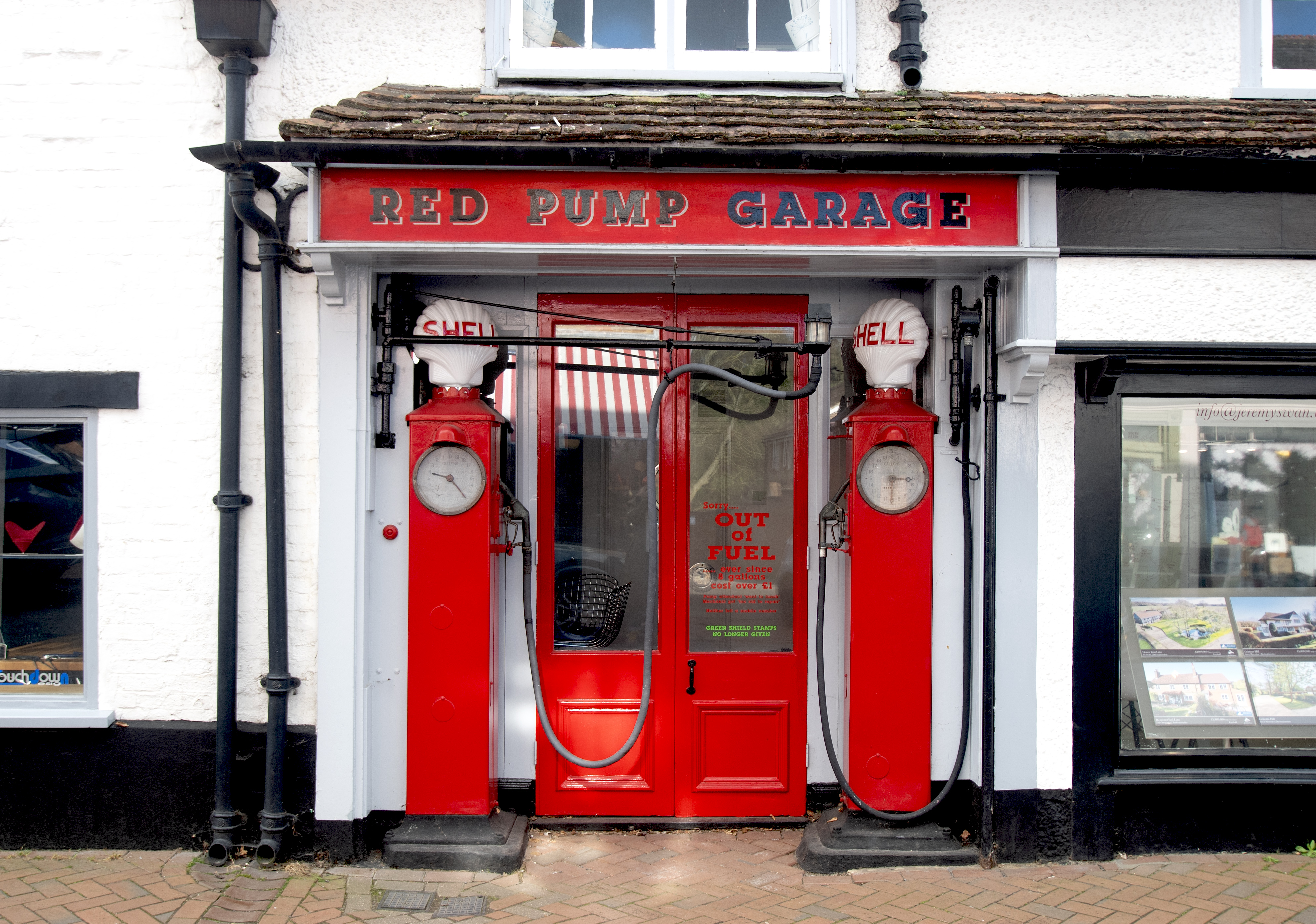

The petrol pumps at 64 High Street inspired the description of the garage in Danny the Champion of the World.  "It was a very small filling station on a small country road, surrounded by fields and woody hills."  Danny the Champion of the World (1975).  Roald Dahl also worked for Shell Oil after he left school.  You can read about that in his book Going Solo (1986).

And because they're so pretty, here's a photo of them under cover of darkness.


5.  Crown House.  This timer framed private residence was the inspiration for the orphanage ("norphanage") in the BFG.


6.  The Church of St Peter and Paul, via the picturesque Church Lane.


It's here that Roald Dahl is buried.  His grave is relatively modest.  Since we left, a memorial bench bearing the names of his children and a poignant quote from The Giraffe, the Pelly and Me has been added:  

"We have tears in our eyes as we wave our goodbyes, 

We so loved being with you we three,

So do please now and then come and see us again,

The Giraffe and the Pelly and me."

There are two giant footsteps leading to the grave.


We had a wander around the old graveyard, higher up the hill.  As I may have mentioned, I love exploring old graveyards...


...but on this day, at this time, we suddenly experienced a wave of overwhelming sadness, thinking of time and people passing, so headed back into the village.

7.  Number 7 on the village trail is The Butcher's.  You can read it here for yourselves.  

Roald-Dahl-Museum-village-trail.pdf (b-cdn.net)

But for added authenticity, here are a couple of photos, courtesy of my Mom.


8.  Buryfields.  This is a play park and amenity ground often frequented by dog walkers.  You can see from the rain laden sky that April is fast approaching.


9.  I once did a school project on this property, one of the oldest in the village.  The oak panelling inside was something to behold.


10.  I received my very first pay packet inside this pub, after a brief stint as a waitress.


11.  Once Town End Farm, I recall visiting the farmer's wife, May, and her sister, shortly after moving here.  I would sometimes deliver their order to the farm house.  Even as a child, the farm house seemed from another time.  I can remember a busy kitchen with a huge pine table, plate racks and fly paper dangling from the ceiling.


12.  House of Letters

Another way I made money as a teen, was to help an elderly lady with failing eyesight stay in touch with her friends.  Remember when people used to hand write letters?  Well, I would sit and studiously write this woman's letters as she dictated expressively to me -  "Dear Bunty..." - all the time thinking which album I would buy with the proceeds.


13.  A collection of cottages and handsome houses.

As you might imagine, nothing really changes in a place like this.  The community spirit still seems evident, but most of the people I knew have moved on or passed on.


14.  The Misbourne River

The mysterious River Misbourne...sometimes visible, sometimes not.  In order to stop this blog from spiralling out of control, I'll pop a link here by way of explanation.   River Misbourne - Wikipedia   It's certainly in rude health now.


15.  The Woods.

After grabbing a hot drink back at the hotel, we ventured out once again and via the back lanes of Missenden, passing Roald Dahl's old house (now occupied by Sophie Dahl and family)... 

...we headed into Hobbs Hill Wood.  For the vast majority of my life I've lived very close to woodland, starting with my time in Great Missenden.  I just feel at home amongst trees and love the nocturnal sounds emanating from them.


Soon, hunger pangs and the dying sunlight persuaded us to retrace our steps towards the village.  We took a slightly different route back and just in time, I was able to capture this stunning pink sunset over Angling Spring Wood, which, incidentally, is said to have inspired Fantastic Mr Fox. Could I have asked for a better memory of our single night stay?


16.  To the pub!

In the Victorian era, Great Missenden was home to no less than 11 public houses.  It's lost a few over the years, but there's still plenty of choice.  We opted for The Cross Keys and enjoyed quite possibly the best fish and chips we have ever eaten.  I even braved the mushy peas, which would probably be better described as "smashed, minted peas" using chefy terminology!  


Above the fireplace it says "Time is precious...waste it wisely."


The place was bustling and the staff and customers very friendly.

There was a wedding celebration in full swing by the time we returned to Missenden Abbey.  In the past, we have been known to gate crash the odd wedding, but decided to behave ourselves on Saturday night and retired to our room for a nightcap and the late film.


Sunday dawned bright and breezy, but I had a couple of places still to visit.  In fact, there was quite a list, but I always need an excuse to return!  

Where were we?  Number 17 I think.

The excellent 2009 stop motion film version of Fantastic Mr Fox (voiced by George Clooney) features The Nag's Head pub.  Here's a film still.


Now, compare it to the real thing.  Can you see the resemblance?  This was Roald Dahl's favourite pub.


Back in the High Street, I had to photograph this gorgeous Corvette Stingray.  I tried to tell the owner that it would suit me way better, but would he listen?


Somewhat reluctantly, we got behind the wheel of our VW Beetle and said goodbye to Great Missenden, heading just a few miles out to Great Hampden and our final destination.

18.  Hampden House.

Fans of classic British horror might recall the 1980s TV series Hammer House of Horror.  Hampden House was purchased by and served as the HQ of Hammer Films during the filming of the series, popping up in many of the thirteen episodes, as well as featuring in the opening credits.

You can read its fascinating film history here:  Hampden House, Gt. Hampden - Hammer House of Horror TV Series

The red kites were circling, but my lens wasn't up to the job so you'll have to take my words for it!


The house is now a very swanky wedding venue (and also once again on my radar).

Sadly, it was time to head home, but we couldn't resist briefly followed the footpath running in front of the property into an area of woodland, only to be rewarded by the sight of this beautiful specimen.  No, not Gareth.  A Giant Redwood.


From one Big Friendly Giant to another.  A fitting way to end my nostalgia trip.


Monday, March 11, 2024

Forest Bathing


Last Sunday dawned bright and beautiful; the perfect Spring day.  So where better to celebrate and soak up some sun to top up our vitamin D levels, but a designated Area of Outstanding Natural Beauty?  

It wasn't quite the weather for forest bathing, muddy puddles still very much in evidence after February's precipitation, but I was sorely tempted.  Cannock Chase is a former Royal Forest and mixed area of countryside in Staffordshire - and a jewel of the Midlands.  

Cannock Chase comprises a mixture of natural deciduous woodland, coniferous plantations, open heathland, small lakes and the remains of early industry, including coal mining.  The Chase was awarded its status in September 1958 and is the smallest area so designated in mainland Britain, covering 26 square miles.  Much of the area is also designated as a Site of Special Scientific Interest.  Despite being relatively small, the Chase provides a broad range of landscape and wildlife, including a heard of around 800 fallow deer and a number of rare and endangered birds, including migrant nightjars.


Popular with mountain bikers, luckily, there's enough space for everyone to enjoy it's tranquil beauty. 

We don't visit as often as we would like, as despite being less than an hour away, the most direct route takes us through the city of Wolverhampton, which can be problematic.  But on Sunday, we found a parking space a little off the beaten track and immediately felt ourselves unwinding, pleased we'd made the effort.


I love a gnarly, moss covered tree!


The clouds were high.  No threat of rain today.  I loved glimpsing the sun-kissed countryside on the horizon.


We really are so lucky to have such natural beauty on our doorstep.  I love a trip to the city as much as the next person, but if there's one thing I'm grateful for, it's that I inherited my parents' love of nature.  There's a lot to be said for having space to breathe and think.  Spending time in nature answers a primal calling.  It's intoxicating.  


Feeling reflective yet?  I might be stating the obvious, but the photo below is a reflection, but flipped horizontally.  It's quite trippy don't you think?


The dipping sun through the trees made for some spectacular sunburst photos.


Now usually, we're not the kind of people who feel naked minus a coffee in hand on a hike, but we were keen to extend the day and so we stopped off at the on-site cafe for coffee (and cake for one).  There was also a war hut close by; one of many across Cannock, used for training around 20,000 soldiers during the first World War.  We didn't stop to explore as time was marching on and we were keen to continue our walk, but I did wonder how many made it back?

Days out with our teenage son are few and far between, but he's also go the nature bug and so joined us - even permitting me to take a few photos.  I made a mental note that the area provides incredible family portrait opportunities.


Spending time in the great outdoors is mood elevating stuff.  Architecture, art and culture are all important, but immersion in nature is vital in my humble opinion.  
Not convinced?  Look at the evidence.

Physical health:

Dog walkers on Kinver Edge

Oxygen released by trees and the resulting fresh air rejuvenates body and mind.  We're bombarded by pollutants, which contribute to respiratory problems and dementia.

Trees also emit essential oils called phytoncides.  These natural compounds help boost our immune system, fight viruses and combat harmful bacteria.

A hike through a forest has obvious cardiovascular and overall fitness benefits.  Each to their own, but I'd much rather don a pair of boots and spend a couple of hours outside than obsessively hone certain groups of muscles on a gym machine in a soulless building.

Mental health:


I'm using a photo of Nanny's Rock on Kinver Edge to illustrate this point.  Taken square on, I always think this lump of sandstone rock looks like the top of a head; the caves a deep set pair of eyes peering out.

Aside from the obvious calming effects of a totally natural environment, studies suggest that spending time in green spaces enhances cognitive function, creativity and problem solving abilities.  My own experiences have shown that long walks help me solve problems and offer perspective.

Spiritual Reflection:

A beautiful example of a tree, Kinver Edge

Dappled sunlight, bird song, rustling leaves; it's almost spiritual.  Even our aesthetic appreciation of trees dates back to ancient times.

As we left Cannock Chase, I caught sight of this mysterious structure...a former British Telecom tower.


We won't leave it so long next time!

We took the scenic route home to enjoy the sunset.  Our VW Beetle doesn't have a particularly fancy car stereo, so we've recently joined the 21st century and invested in a blue tooth gadget.  We can now play our choice of music via my phone through the car stereo. Joy!


A little post script.  My Monday morning view from the kitchen window was this little robin making a nest in the ivy.  For once, I had the right lens on my camera and managed to capture it in all it's glory.  Nature perfection!


I'm curious, do my fellow bloggers have a favourite walk?


Saturday, March 2, 2024

Tunnel Vision

Hello!  I'm checking in after another self imposed period of absence from the screen.  Eyes and screens are not great bedfellows and eye strain is a recurring problem for me, my phone being the biggest culprit.  Talk about 21st century problems!

We are living in dark times and there are times when I'm finding it hard to find the light.  Photography continues to push me to do so.  Here's the moon glimpsed through our roof window, criss crossed by thorns and slightly soft focus rosehips.  I'm slightly irritated by that, but quite like the overall magic of the scene.


I appreciate the escape that Blogland offers, but there are some things that just shouldn't be left unsaid.  All life is precious and every single one that is cut short by war or malevolence is a tragedy.  The world's problems are numerous, widespread and currently feel insurmountable.  Yet in this turbulent world plagued by violence, intolerance and corruption, Alexei Navalny was one soul who offered a glimmer of hope, albeit in the dim and distant future. 

Incomprehensibly, he's no longer with us....yet another light that has gone out.  If you've never seen the Oscar winning documentary "Navalny" you really should.  It's inspiring stuff and his bravery clearly knew no bounds.  After viewing what I could of his funeral yesterday on YouTube, I felt moved enough to immortalise him in this revolutionary-style poster, alongside his chosen final message.


February has been one of the wettest on record, so our walks have been few and far between.  I've realised that dampness has a huge impact on how cold I feel.  Crisp, dry air, even when the thermometer is hovering around zero, is much more comfortable than 7 or 8 degrees in damp conditions.  

That said, we continue to discover new places on our doorstep.  Regular readers will know that Kinver Edge, the National Trust managed area, is a beloved local beauty spot of ours.  In amongst the 600 acres of land, are hidden places of intrigue and last weekend, we ventured to the perimeter and beyond and stumbled across another one - a Grade II listed monument - hidden deep in dense woodland. 


It bears the following inscription: 

"This pillar commemorates 
That devoted man Richard Baxter
Minister of the Old Church.
Kidderminster about the year 1650
And whose unwearied labours
Were so greatly blessed to that
Town and neighbourhood.
Read his Saints everlasting rest
And call to the converted."

The pillar monument, erected circa 1850, stands tall, but nonetheless is somewhat dwarfed by the surrounding trees.


Now, I'd never heard of this Richard Baxter, so after a little research, I discovered that Baxter was a Nonconformist Puritan minister, theologian, poet and hymn writer (he had a lot going on!) 


His ministry in nearby Kidderminster was controversial because Baxter's strong views on justification and sanctification, with their emphasis on faithfulness and repentance, were unusual.

Baxter was elected as minster by the people of Kidderminster after being invited to deliver a sermon.  He was twenty six.  He had a long and eventful career, dogged by persecution in one form or another. 

He was ejected from the Church of England after the 1662 Act of Uniformity.  However, he became one of the most influential leaders of the Nonconformists in the 1600s, partly because of his prolific theological writings, partly because of his prosecutions and his time in prison for various faith related offences.  

You can read about his turbulent life and divisive theological views here:-


Just a stone's throw away from the monument, is the Drakelow Tunnel complex, a former underground military complex covering 26,500 square metres with a total length of 5.6 km.  They were originally built as a Second World War Shadow Factory and were developed during the Cold War to be a fall back government centre.

British shadow factories were the result of the Shadow Scheme, a plan devised in 1935 and developed by the British Government in the build up to World War II to try to meet the urgent need for more aircraft using technology transfer from the motor industry to implement additional manufacturing capacity.  The term "shadow" might suggest secrecy, but in reality it was a reference to a protected environment staffed by motor industry employees of all skill levels working alongside (in the shadow of) their own similar motor industry operations.


The Drakelow Tunnels Museum is now open after spending a number of years in private ownership.  Inexplicably, we never got around to visiting before the complex (the largest underground tunnel complex in the UK) closed in the 1990s and I was unaware until recently that it had in fact reopened after a painstaking transformation into a family friendly Cold War Museum.  I've dropped them an email to plan our very first visit!

Given that the echoes of this dark chapter of our history are reverberating loudly now in 2024, I'll leave you with some positivity.

First up...a beautiful sunrise captured last week.  Our house sits on the fringes of the West Midlands conurbation.  In one direction, we have a fairly urban skyline as evidenced by this photo.  In the opposite direction, we have woodland and countryside stretching all the way to Wales.


The low lying mist and pale pink sunrise makes everything look beautiful!

In the garden, Squirrel Nutkins is up to his usual antics, robbing great chunks of fat balls from the disgruntled robins and blackbirds.


As much as I can't stand the rain, we witnessed some beautiful cloud formations over Walton Hill (another local beauty spot with incredible panoramic views over town and country).


Today, I scored these apparently unused M&S hiking boots from a charity shop for £7.00 and am choosing to ignore the teen's cruel "Ronald MacDonald shoes" comparison.  


Whilst it might not feel like Spring right now (snow fell on high ground last night), nature definitely received the memo.


But the big news in these parts, is that last week, Staffordshire County Council served a notice on the owners of The Crooked House (Britain's Wonkiest Pub), to rebuild it within 3 years, exactly as it was before the arson attack and unlawful destruction.  Regular readers will recall that we were outraged last August when yet another piece of local heritage was laid to waste, allegedly by individuals motivated by financial gain.

You can read my post written in the aftermath here:- Winter Peach Photography: A Very Crooked Tale

The campaign group have plans for an event on the anniversary of its demolition, which include inviting along the band originally booked to play on the eve of its destruction - Gasoline and Matches.  Yes, really!

There's a way to go yet, but it's definitely seen as a little victory and a big step towards the pub making a return!


See you soon!


A Fond Farewell

We've all heard of the proverbial "pain in the neck."  Well, for the longest time, I've been waking up with a cricked neck...