Showing posts with label laburnum arch. Show all posts

Saturday, September 17, 2022

Farewell Summer, Hello Autumn


Long time no speak!  It feels particularly autumnal here right now.  I've already consumed the lion's share or not one, but two, crumbles (an apple and blackberry and a cherry), have had hairy encounters with a couple of muscle-bound spiders and the nights are most definitely drawing in. 

Betws-y-Coed, "False Autumn", August 2022

Events have conspired in recent weeks to keep me from the keyboard.  I'm now pretty familiar with the labyrinth of corridors and departments that is our local hospital after accompanying Mom to various appointments and also suddenly being called in myself for a minor op I had been waiting almost a year for.  

I went in bright and early a couple of Sundays ago and almost had the ward to myself.  The staff were attentive and thorough and by lunchtime, I was done.  So far so simple I thought.  Not so.  I was prescribed a course of antibiotics - a belt and braces approach to infection avoidance, which I started taking later that day.  But on Wednesday morning, I noticed I had what appeared to be a black eye.  As I examined my reflection in a mirror, the area around my eye was swelling before my eyes (well my good eye), transforming me into the Phantom of the Opera.  

I hurriedly arranged an appointment with my GP and was told to stop taking the antibiotics and immediately start taking antihistamines, as there was no infection in my wound.  I had a tense 7 days, waking each morning and wondering where the swelling would be that day or if it would worsen.  It seemed to move around my face each morning until eventually, it dissipated.  I was told that it could possibly have been a reaction to the antibiotics, but that such swelling is also a very common reaction to illnesses such as flu (I have had a sniffle).  Who knew?

My latest look was born of necessity until my stitches were removed.  

I have also been busy organising my forthcoming photoshoot, which, now falls on a designated UK Bank Holiday, courtesy of Queen Elizabeth II's funeral.  Mercifully, not one member of our little team of suppliers has backed out.  We've all invested far too much time and effort to abandon our plans at this late stage.

Consequently - and with our first Autumn ground frost this morning - it seems like an age ago that we were basking in the balmy Welsh sunshine.

I'm going to rewind to the final couple of days of our getaway and our pilgrimage, on foot from the village, to one of the most remote churches in the UK, Llangelynnin Old Church.  Positioned high on the hills above the Conwy Valley, some 900 feet above sea level, the church is dedicated to a local Saint, St Celynnin who lived in the 6th Century and probably established the first religious settlement on this site.  

The views on the ascent were stunning.


It's hard to convey the isolation, but I did my best with some wide angle shots and a short video.

Within the church grounds, lies the Holy Well.  It's possible that this was used by the Saint in the 6th century as a water supply or to baptise those who converted to Christianity.  As time passed, locals believed the water to have magical healing properties, particularly for sick children.  Clothing belonging to the sick children would be tossed into the water.  If they floated, it was assumed that the child would recover.


People lived in the uplands before the wooded lowlands were cleared and the present hill tracks would have been the main routes in Celynnin's time.  The church as it stands today dates from the 12th century and was in regular use for worship until 1840 when a new church was built down in the valley.  In 1932 and 1987 major restorations of the church were carried out and now services are held here during the summer months and on special occasions.


The porch is 15th century with an unusual squint window in the east wall.  The porch roof was repaired with purlins of yew, which may have grown in the now almost tree-less graveyard.


The threshold and hinges of the door are believed to be 14th century, although the door itself is a later addition.


The nave is the oldest part of the present church, dating back to the 12th century.  The benches are 19th century.  Hanging on the wall of the nave there is a bier that was used to carry the remains of the dead to their final resting place.


The chancel is probably 14th century.  You can just glimpse the remains of a boarded barrel roof in the photo above.

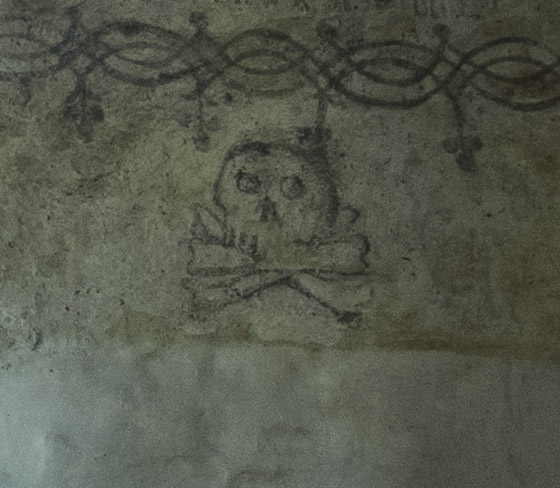
This fascinating skull and crossbones detail was discovered a when layers of time and whitewash were removed, revealing the Ten Commandments in Welsh.

Back outside, the clouds were playing to the camera...


...and I managed to capture a beautiful sunburst.


The North Wales Pilgrims' Way framed by the churchyard entrance.


A special place indeed...and for the record, after this particularly energetic workout, I should have doused myself in water from that Holy Well to ease my aching thighs for the next few days.  For more on St Celynnin's, here's a short video.

Wild, Windy Worship. - YouTube

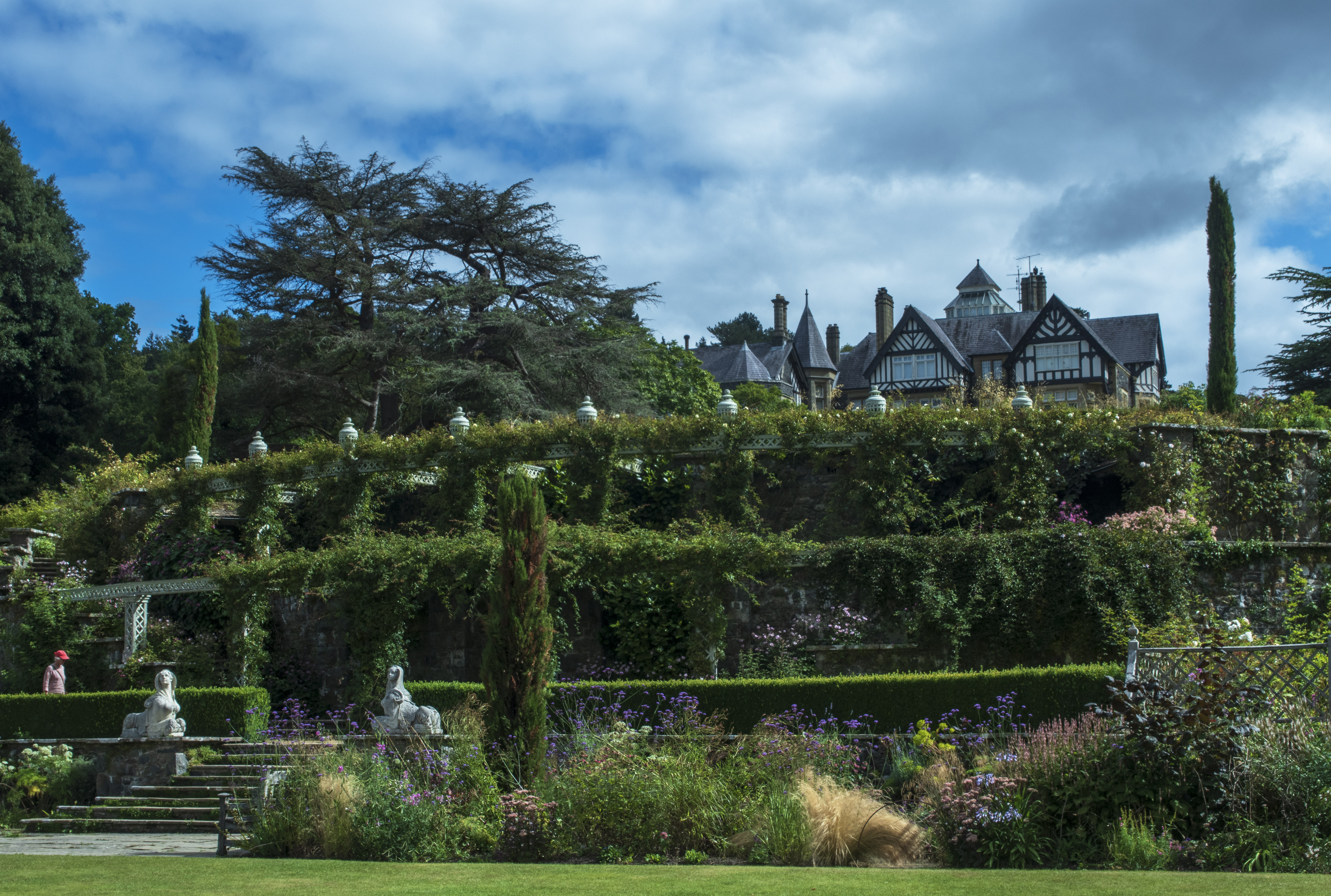
Of course, we couldn't leave this part of Wales without paying a visit to Bodnant Garden, an NT managed, Grade I listed horticultural gem comprising 80 acres, just 10 minutes' drive from our cottage.


It was founded in 1874, developed by five generations of one family and given to the National Trust in 1949.  The garden's founder was Henry David Pochin, a Leicestershire-born Victorian industrial chemist credited with inventing white soap.  He became a successful businessman, mayor and JP.  His wife, Agnes, was from a wealthy Scottish family of ship builders.  

Originally just lawns and pasture, Pochin and his employee Edward Milner redesigned the land around the Georgian manor house, relandscaping the hillside and valley, planting American and Asian conifers on the banks of the River Hiraethlyn to create a Pinetum and reinforcing stream banks to create a woodland and water garden in the valley.  


It was here we encountered this fallen giant (originally planted in 1887 and standing over 50 metres tall), one of 50 lost in Storm Arwen back in November 2021.  

The enormous team of 20 full time gardeners were hard at it, burning rubbish just out of sight from visitors.


In the upper garden, a Laburnum Arch was created and glasshouses to house exotics.  


From 1905 to 1914, five terraces were completed; an enormous undertaking of manual labour involving the levelling of hillsides, movement of earth and the construction of granite buttress walls to protect the tender plants being introduced from overseas.


The much photographed Pin Mill building on the Canal Terrace was added in 1938.  Originally built as a garden house in 1739 in Gloucestershire and later used as a pin factory and then a hide store for a tannery, it was rescued from decay by Henry's grandson - Henry McLaren, who dismantled it, brought it to Bodnant and rebuilt it brick by brick.  


As you might expect, there was a fountain or a statue at every turn.


Situated on a steeply winding path running from the valley to the terraces, was the family Mausoleum. Sadly it was closed to visitors on the day of our visit....  


....but I did manage to get a glimpse inside through the impressive entrance door panel grills.


Throughout the 1900s the continued development of the garden was a partnership between three generations of the McLaren family - Henry, Charles and Michael.  Charles' sister, Dr Anne McLaren, was one of Britain's leading scientists.  She pioneered techniques of reproductive biology, which led to IVF and cancer research.  The current owner is Michael McLaren, who inherited in 2003.  He is a practising Barrister, working in London, but continues to act as garden manager.  A family of high achievers for sure, but also philanthropists.  It's not lost on the volunteers and locals just how much they are indebted to the McLaren family, who have saved huge swathes of the Conwy valley from development.  


Bodnant is hands down the best National Trust garden we've visited to date, but one visit just isn't enough to grasp the scale, detail and myriad plant species on display.  We shall return.


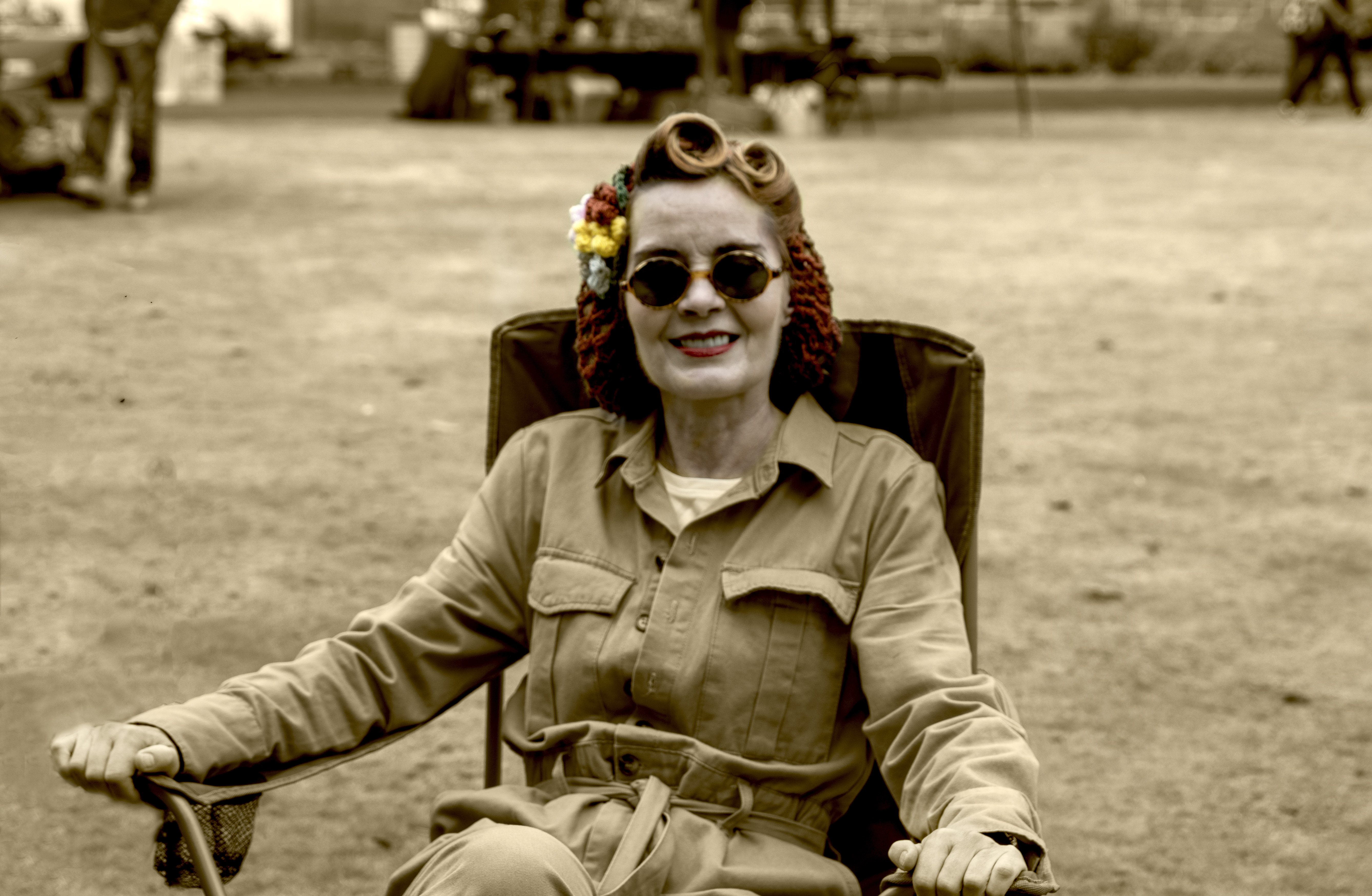
I'll leave you with a few random photos from the past couple of weeks.  First up, a photo I am calling "Portrait of a Stall Holder" captured at an Antiques Fair at Hartlebury Castle in neighbouring Worcestershire. I loved her vintage style, which was well suited to her life as an antiques trader. 


She is also the proud owner of this cool ride, a 1959 Edsen Villager Cruiser.


I helped fund her expensive running costs by purchasing some vintage decorative green glass tableware for the boudoir.


Also green - and I suppose quite decorative - is this punk amongst caterpillars.  Feast your eyes on this fuzzy noodle of fun!  It's a Pale Tussock caterpillar and the first I've ever seen!  Spotted outside our 


Take care, stay warm and I'll see you soon. 

Sunday, April 3, 2022

Horticulture, History and a Hint of Intrigue

We may be fully vaccinated, but we are determined to avoid Covid if at all possible, particularly now a close family member is facing numerous hospital tests.  We can't afford to pass anything on.  Last week's stats made for scary reading.  One in thirteen people in the UK had Covid last week - that's 5 million people.  We now have 20,000 people in hospital with Covid (although not all for that reason).  People may not be dying in such scary numbers, but according to one NSH worker we were chatting to yesterday, the situation in hospitals "is very bad."  

Anyway, we've been quite happy roaming around the great outdoors, especially when the temperature last weekend topped Spain's.  Our chosen destination last weekend was Arley Arboretum, sitting on the banks of the River Severn in the hamlet of Upper Arley.  It's one of the area's hidden gems and is one of the oldest Arboreta in Britain.  Well, I say hidden, but I still managed to bump into an old primary school friend.


It was originally planted by Earl Mountnorris in around 1800 and contains many exotic and rare tropical plants and one of the country's finest specimen tree collection.  


Ownership subsequently passed to Robert Woodward in 1852, before being acquired - in a state of neglect - by Midlands industrialist and philanthropist, Roger Turner in 1959.  Turner took on responsibility for the picturesque hamlet, building 27 new properties, restoring the arboretum and Grade II listed walled garden and bringing the community together by erecting a Sports & Social Club. 


Prior to his death in 1999, Turner, with great foresight, had taken steps to protect the Arboretum by setting up a charitable trust.  He bequeathed the entire 1600 acre Estate to that Trust.  The Trustees took the decision to open the arboretum to the public, having decided that it held sufficient educational importance.  It was officially opened to the public in 2002 by Lord Lichfield.

The Arboretum boasts a wonderful Laburnum Arch measuring 65 metres, sadly not in flower at the time of our visit.


Also, the usually spectacular Italian garden was missing its fountain and one of the pools had been drained.

However, the 300 species of trees dating back over 350 years, the blossom and the acres of magical woodland walks and views more than made up for this.


We even reverted to childhood and entered the Hornbeam maze.  Clocking that the laid hedgerows weren't yet in leaf, I scoffed as we entered, suggesting that this would be a doddle, only to exit, alongside a tearful pre-pubescent 20 minutes later.  He was upset that his biggest fear of getting lost in a maze had been realised.  As for me, I was just a quitter.  


Here's Gareth calling me a loser from the centre.  It still took him way too long to fnd it!

I received a copy of Irish singer/poet Imelda May's poetry collection for Mother's Day after dropping the heaviest of hints.  The collection includes a foreword by Irish Novelist Roddy Doyle and is accompanied by Imelda's pencil drawings.


Here's a lovely little example entitled "Etta."  Apologies in advance for the stream of consciousness layout, but Blogger would not permit single line spacing!

The sun sneaked its head out from a volatile sky and winked at pansy smiles that got the joke Etta James sang her soul out from across the divide and I danced in my slippers with a heart of love and hope.

Back home in the garden, the magnolia is finally in flower and has miraculously defied this year's late frosts.  Here is is, pictured at dusk on Wednesday evening.


Joining me on my evening garden exploration, was Lotte.  The only way I can distract her and stop her relentless head bumps (which mess with my focus), is to throw a twig or a leaf for her to hunt down.  Here she is, my perfect furry muse, hunting her imaginary prey amongst the daffodils.


Later in the week, we were treated to wind, sleet and snow flurries before the weather finally settled into squally rain.

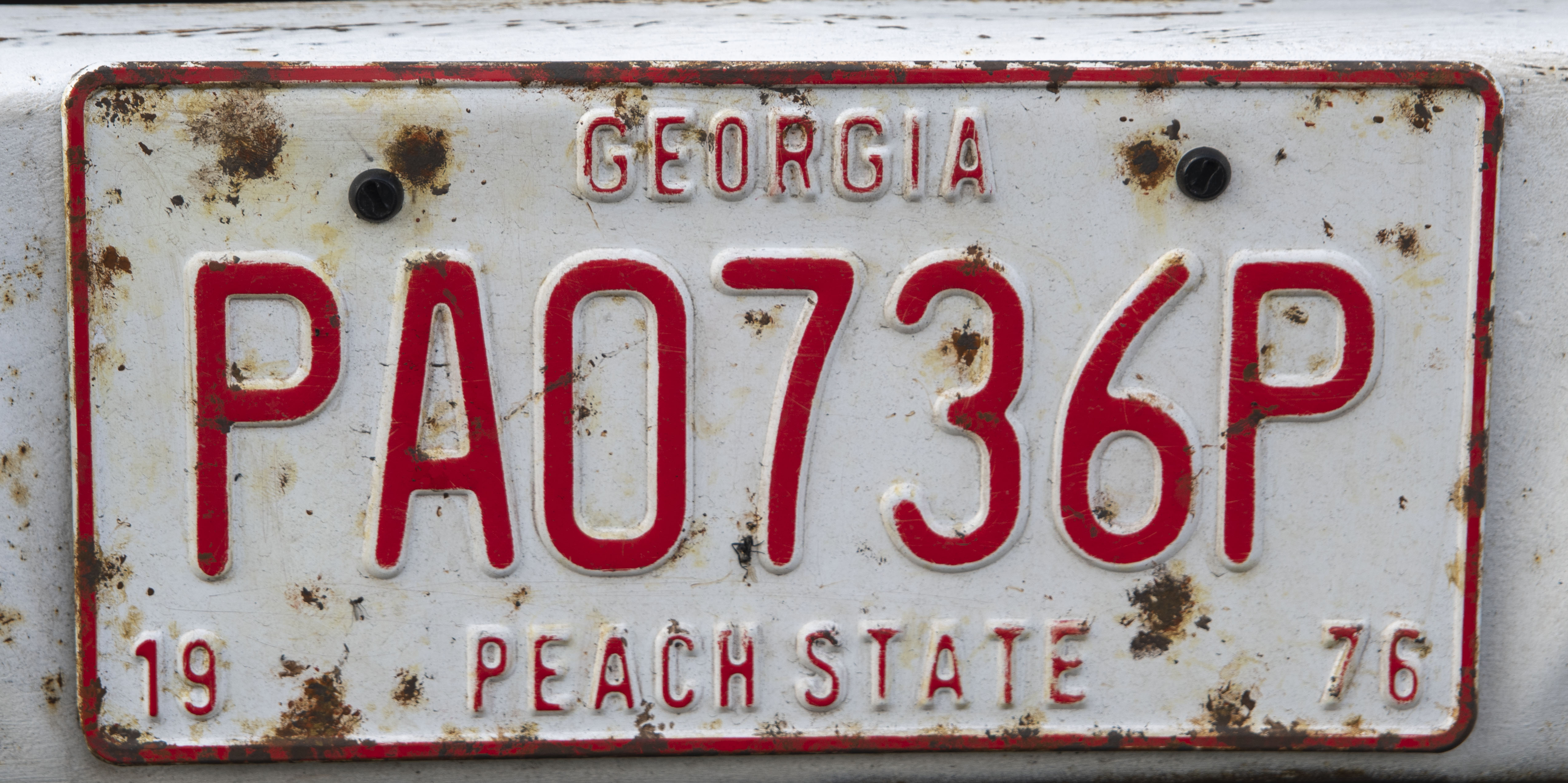
Yesterday, we met up with a customer who was in the area and wanted to collect his latest order of rust paint.  He's transforming this amazing old farm truck imported from Georgia Texas.

For any petrol heads, here's the engine he built himself.

These license plates cost a pretty penny.

                        .

I'm sure by now, you've spotted that behind the handsome Ford truck, is a handsome old building.


 Introducing Harvington Hall, a moated Elizabethan Manor House.  


The moat and artificial island can be traced back to the 13th century, making them even older than the majority of the 14th century building work that still survives behind a layer of brick. 

The property houses the largest number of priest holes (7) than any other property in England and houses an impressive collection of rare Elizabethan wall paintings.  

Friends of ours married in the neighbouring church back in the early 2000s and we all enjoyed a lavish wedding breakfast within the walls of Harvington Hall.  A wonderful memory.


Harvington's history is naturally rich in stories.  Adam he Herywnton (Harvington) lived and almost certainly died here in March 1344.  Upon his death the estate passed to the Earl of Warwick and in 1529 was sold to a wealthy lawyer, Sir John Pakington.  Curiously, there is documentation to say that Pakington was provided with a special grant by Henry VIII no less, permitting him to wear his hat in the King's presence!

Sir John's great nephew, Humphrey Pakington, inherited the estate in 1578 and the manor we see today came into being.  


Unfortunately, being Catholic, Humphrey was repeatedly fined for his refusal to attend the Church of England Sunday services.  The fines started at 12p per week but increased to £20.00 per month, equating to around £4,000 today.  When, in 1585, it was made illegal for a Catholic priest to step foot in England, Humphrey equipped Harvington with ingenious priest holes (including a "swinging beam hide"), which visitors can see today.  Some of these were almost certainly the handiwork of master carpenter Nicholas Owen (who met his own death in the Tower of London in 1606).


A potted history, post Humphrey.  Harvington became the dower house of his widow, Abigail.  Upon her death, Harvington passed to daughter Lady Mary Yate in 1657.  Mary died at Harvington in 1696 at the grand old age of 85.  As she had outlived her son and grandson, Mary's granddaughter, another Mary Yate.  Mary was married to Sir Robert Throckmorton of Coughton Court (now under the care of the National Trust).  Sir Robert had very little use for Harvington and so demolished two wings of the property and in the 19th and early 20th centuries, most of the furnishings were stripped, leaving the hall in a dilapidated state.  


With only two generations of gentry living at Harvington, the house was restored, courtesy of the generosity of a new owner and Catholic lady, Mrs Ellen Ryan Ferris, who in 1923 purchased the Hall and gifted it to the Archdiocese of Birmingham, who still own the hall today.

Outbuildings including cafe, cottages and Georgian Chapel

Yesterday's visit was confined to the grounds and the Georgian chapel, which are free of charge to enter, although we both intend to return for another guided tour as soon as possible.  


A glimpse inside the Georgian chapel.  The light was exquisite.


We also took a stroll down memory lane for Gareth, visiting the location of his first job at another historic local landmark - Hagley Hall Mews.  Fresh out of uni, Gareth was employed as a product designer at this lovely location. 

Here you'll have to use your imagination and conjure a mental image of a courtyard surrounded by converted stables, each housing small independent businesses.  For some reason, my memory card appears to have erased these photos!

Lunch hours (or half hours) were spent wandering the footpaths on the Hagley Hall Estate, a Grade I listed 18th century house in Hagley, Worcestershire, the home of the Lyttelton family, currently owned by the 12th Viscount Cobham.  

Here's the church of St John the Baptist, 


there's the steeple, 


go through the lychgate...and here's a lone teen scrolling on his phone!  OK I'm paraphrasing the old nursery rhyme, but you get the picture.  Incidentally, I have a confession.  The line "I am the resurrection and the life" was introduced to me not via Bible studies, but by The Stone Roses, atheist that I am.


The deer were out in force in the deer park, but you'll have to take my word for it.  Pre dating the Palladian mansion and once considered amongst the greatest of all landscaped gardens, today, the park is under construction and not open to the public after almost 150 years of neglect.

There are numerous follies connected to the estate, scattered around Hagley, one of which can be glimpsed from the summit of Clent Hills.

Another, the Grade II listed Hagley Obelisk, stands close to the summit of Wychbury Hill in Hagley.  Here is it, just visible on the hill above the housing estate.  

The obelisk was constructed in 1747 under the orders of Lord Lyttelton.  However, the monument  for over three quarters of a century, has become part of local folklore courtesy of a very intriguing tale and was also branded with graffiti referencing the local mystery.  But I shall keep you in suspense until my next post!


A Fond Farewell

We've all heard of the proverbial "pain in the neck."  Well, for the longest time, I've been waking up with a cricked neck...