Showing posts with label art deco. Show all posts

Friday, February 11, 2022

Pet Cemetery and the Great Glass Mood Elevator

Bear with me on the title of this post....all will become clear.  Crystal clear.

Last weekend, after a tip off from Simon, a photographer acquaintance and explorer extraordinaire (check out his incredible recent drone photography on Instagram @sabphotos69), we headed a mile or so from our back door, to a little known Nature Reserve.  I say "little known" as unbelievably, we had never heard of it, despite skirting around, up and over it, throughout the years.  However, on this occasion, our mission was to find evidence of what lies beneath.


Overlooking the Smestow brook in neighbouring Staffordshire (here in Kingswinford, we straddle the border between Staffordshire and the West Midlands conurbation), the nature reserve started life as a 19th century ornamental wood, planted on a hillside close to the Chance residence.  

The Chance family were a West Midlands industrial dynasty. Originating from Worcestershire, they carved out a reputation for pioneering technology in glassmaking (and as hard nosed businessmen) after taking over a factory in Spon Lane, Smethwick in 1822.  Going from strength to strength, Lucas and William's business produced sheet glass for London's Crystal Palace and the Houses of Parliament and the white opal glass on Big Ben's clock face.  The brothers also mastered the sophisticated lews technology which revolutionised lighthouses along the sea routes of the world. In addition, they were known for popularising the vibrantly coloured slumped (kiln made) glass tableware, Fiestaware.

Chance Wood contains an interesting collection of trees from mature beech and oaks to hornbeam horse, sweet chestnut, silver birch and rowans.  The ground cover comes in the form of wood sage, foxgloves, rhododendrons and snowberry.  Ordinarily, this would be enough to keep me occupied with my camera, but having a dark heart, the star of the show for me was the Victorian pet cemetery.  

The graves of long dead, once beloved family pets were scattered amongst the undergrowth and stacked against the silver birches - perfect ghostly companions for all eternity.  

Even more curious were the inscriptions on some of the head stones.  Whisper: a lovely name, but a terrible end. 

Should it need pointing out, I felt that photographs of a Victorian pet cemetery were deserving of appropriate edits and so I created a texture and experimented with tones and contrast, to create a wet plate photography aesthetic (something I am currently a little obsessed with).
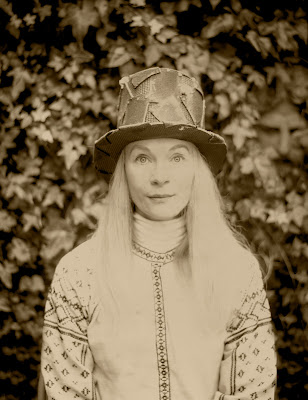
I will haunt you!

Venturing down onto more familiar turf, we followed the Smestow Brook a short way...

...and stared in awe at the spectral oak trees,


...before picking up a footpath crossing farmland and back towards Stourton Castle, a medieval hunting lodge dating from the reign of William II.  

During the reign of Henry II it became known as "the King's Houses".  By 1122 it was known as a castle.  

The castle has a long and chequered history, but here are a few highlights.  Skipping a few centuries, by 1475, the castle was in the ownership of the Duke of Clarence who, in that year gave it to Tewkesbury Abbey.  The castle was returned to the crown in 1495. 

Notably, the Castle was the birthplace of Cardinal Pole, whose maternal grandfather Clarence, was the brother of both King Edward IV, and King Richard III.  Pole was the last Catholic Archbishop of Canterbury and his mother Margaret Pole, 8th Countess of Salisbury was beatified in 1886 by Pope Leo XIII.

There are also links to Henry VIII and a forcible change of hands during the Civil War.

The house was remodelled and partially rebuilt in 1832-3.  It was bought by glassmaker, Francis Grazebrook, a relative of the earlier tenant, and remained in the family until the death of his son O. F. Grazebrooke in 1974. The 19th century main front incorporates a late medieval gate tower.

Of course, it's no surprise that links to the glassmaking industry are everywhere in this part of the world.  Wordsley, my birthplace, was once a key player in the glassmaking industry.  Therefore, it only seemed right to finish the week with a visit to another local landmark, the Red House Glass Cone Museum.

There were numerous glassworks in Wordsley from 1776 until 1930, making artisan created cut glass items such as vases, glasses and objets-d'art. The famous replica of the Roman cameo glass Portland Vase was cut in Wordsley.   Read about it and see it here.  Collection Search | Corning Museum of Glass

One of the most famous glass designers was a Wordsley man, William Jabez Muckley. Another was John Northwood, and his son Harry, who helped establish glassware in the USA. Yet another who established glassware in the USA was John Northwood's friend, Frederick Carder. One of the most accomplished glasscutters was George Woodall, whose campaign led to the building of the Wordsley School of Art (sadly demolished in 2001 - much to the outrage of many local residents. 

Only a few foundation stones were saved....by another local Glass Museum.


From our illustrious past, the Red House Glassworks
, a 100-foot high glassmaking cone, survives.  Here are some glimpses of the cone on our approach along the High Street and then via a Wordsley back street.
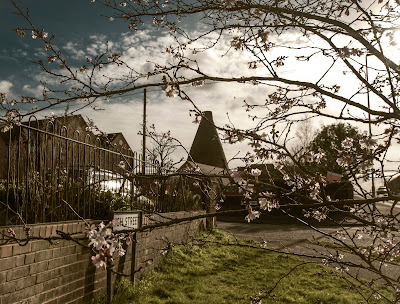
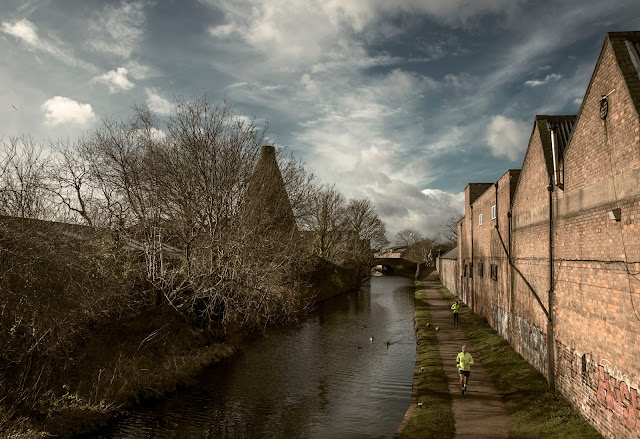
View of the sixteen locks stretch of the Stourbridge canal towpath and the iconic Glass Cone 


Lead-crystal cut glass from Wordsley's heyday is now rare and collectable. Glassworking continued in the area, albeit at a reduced scale, until the 1990s.

Like most towns in the Black Country, regeneration is needed, but the cone is a huge source of local pride and its newly erected neighbour, the Stourbridge Glass Museum, is scheduled to open in April this year.  Hopefully this will further raise the Glass Quarter's profile.

Perched on a hill next to the Wordsley canal, my visit to the Red Cone was a great mood elevator.  It's so easy to take for granted these relics from the past - literally on our doorstep - and our historical significance worldwide.  With my mother in tow, our visit was impromptu and all too brief, but no matter, we can pop back at any time as the admission's free and it's within a 10 minute walk of my Mom's house.  

I loved the Art Nouveau glass safely hidden behind glass cabinets.


Inside, there are numerous exhibits and information boards, including this one, which featured a woman my Mom immediately recognised as a neighbour from her childhood.


We visited the "Shrower" a room which would have been kept under lock and key so that no goods could be removed.  My grandmother would have once worked inside such a room, checking the glass and inspecting it for faults before sending it to other areas of the factory for decoration and packaging.

Below is the annealing oven or "Lehr".  Incredibly, it is now the only remaining example in the world.


There are aspirations for the Black Country to become a Global Geopark due to the wealth of materials just below its surface and the labours of the people who used them.


Clearly the canal network greatly assisted in the transportation of goods and raw materials.

Outside, there are a number of local artisans operating inside these units, 


like this fine artist, specialising in charcoal portraiture,


and a lovely cafe with canalside seating.  


Don't be fooled by the blue skies.  There was an icy wind that could cut glass all by itself, so we shall make a more leisurely return visit soon.

Here's a view of the majestic Grade II listed Cone.  Unfortunately, high winds and heavy rain have damaged the bricks and mortar, so the cone is currently closed to the public whilst Dudley Council continue to raise funds for reparatory work...


...but it's still perfectly safe to take a peek inside from the safety of the doorway...and what a view!  


The glass furnace at the centre of the cone has a 7m diameter and is 3m high.  It would be brought up to temperature (a mere 1250 degrees centigrade) and held at this temperature for around 30 hours, in order to turn the glass to a honey-like consistency.  It could then be gathered up on the end of a blowing iron.


An unofficial rule of photography - don't forget to look up!


On the walk home, we cut away from the "cut" (canal), 


passing through an estate of 1930s houses.  Through a gap between these houses, we glimpsed another local landmark - Wordsley Manor.  


Readers of my blog might recall my recently produced postcard sets Shop | My Site 15371 (winterpeach.co.uk),  which featured this photograph of a jaw dropping Art Deco cinema, hidden deep within the walls of, you guessed it, Wordsley Manor.  I captured it in all its faded grandeur a few years ago when the Manor came up for auction.  


So there you have it.  A little local exploration, urban and natural and all within 15 minutes of my humble abode.  

I'm off to see Kenneth Branagh's Golden Globe Award and BAFTA nominated film Belfast later.  Have a good weekend all!  Until next time!


Thursday, August 5, 2021

Black Country Colour and Culture

Saturday's excursion to a Shropshire market town to meet my screenplay contact in person for the first time, was thoroughly enjoyable, although Sarah and I had to abandon our meeting after an hour, due to the great British weather, which insisted on precipitating all over us and my notes.  We were both on the same page - literally (we met to read through my treatment over a coffee) - and figuratively in terms of avoiding the insides of drinking establishments.

In other news, our son had attended a bowling party and had received notification that one of the girls had later tested positive for Covid, so 10 days of isolation for him - not that it's much of a deterrent for a teenager.  Ten days confined to the your bedroom with mobile phone and gaming pc?  The horror!  For the record, we didn't insist he remain in his bedroom - he just prefers it that way as our company, conversation, TV choices and humour are just intolerable.

To be on the safe side, we decided to abandon a planned visit to Chastleton House, as we had arranged to share a car with a couple of old timers and we're still being cautious.  We may all be double jabbed, but I wouldn't knowingly put someone at risk of catching Covid, in exactly the same way that I wouldn't inflict a bad cold or bout of flu on another.

Instead of galivanting around the UK, we focused again on the garden, cutting back the ivy which has been gradually encroaching on the patio area, covering everything in its path....including not one, but two rat bikes (show props).


   This is what it looked like before....

....and now.  No huge difference, but more space and a big reveal of our curious stone head (I wondered where he'd got to).


Having tidied the area, I decided to plant Mexican Fleabane in the chimney pots.


My recent blog was all about pink.  This time, the focus was firmly on blue.  The hydrangeas are in flower.   We have two blue ones in slightly different shades, courtesy of variations in the soil?  


I also managed to get my hands on one of the elusive blue tinged geraniums from Ashwood Nurseries.  It's planted by the rusty dwarves and I'm hoping it will spread everywhere like its pink relative.


I planted another couple of evergreen ferns to take hold in the shade of the Magnolia tree...


...and treated myself to this very showy French Hydrangea, now illuminating the top of the garden beneath the woodland canopy.  I picked the one with the tallest shoots and am willing it to reach its 5-6 foot optimum growth as soon as.


Meanwhile, Gareth tackled the wisteria busy claiming the guttering at the side of the house, which was all fine and dandy until he disturbed a wasps' nest and descended the ladder at warp speed, swearing his head off.  They might be the thugs of the insect world, but they create beautiful homes.  Here's one I photographed in a hedgerow a couple of weeks ago.


We decided to give Dr Jones (our illustrated mannequin and work of local artist, Yvette) a dose of vitamin D and showed him our handiwork.  Yvette's Instagram moniker is @creative_curiosities.  You can view her work here yvette appleby (@creative_curiosities) • Instagram photos and videos.  Yvette kindly allowed us to take Dr Jones to our first trading show and he was such a hit and - very weirdly - became part of the family.  For a few weeks, he sat, brooding (he tends to do that) in our front room.  Eventually I got used to him and stopped jumping out of my skin every time I entered the room.  We also grew to like him.  He's really no trouble and is easy on the eye, if not the best conversationalist.  We therefore struck a deal with Yvette and he lives with us.  We launched an online competition to name him and so, to give him his full title, please allow me to introduce you to Dr Edwin Jones.  


We also squeezed in a walk around the lake within the 180-acre parkland of Himley Hall, a beautiful 18th century house and one time home to the Earls of Dudley with grounds landscaped by Capability Brown.  


Himley Hall is only around 3 miles from our house, but the walk would take us along a busy road, so we opted to park in a nearby side street to shorten the less interesting leg of the journey.  This shortened walk took us past another property of historical significance - Holbeche House, central to the Gunpowder Plot.  Allegedly there are visible bullet holes in the exterior walls.  It's now a nursing home, which I think is a real shame.  I would love to have a closer look.  As it stands, I only have TV adaptations to help me visualise Catesby and co. drying out their gunpowder in front of a roaring fire with disastrous consequences.  For the record, quite a bit of work went into this image.  I have removed several sleeping policemen, a car and some distracting care home signage from his photo.  The lengths I go to!


There was a mini show on at Himley on the day we visited, just visible from across the boating lake in this moody photo.

Spot the moorhen amongst the lily pads.

Another historic Black Country attraction has taken up residence in the grounds at Himley Hall.  Matthew Jones & Sons' Victorian Fairground has been in the same family for five generations and was, until recently, located at the Black Country Living Museum.  I couldn't resist the chance to snap the fair during a rainy set-up and Matthew ushered me through the barrier gate to get some shots.


From wet fairgrounds to Wolves - specifically a visit to the city's Art Gallery (with a few photo stops on the way).  Here's an intentional camera movement abstract take on the Art Deco frontage of the once booming department store Beatties, which sadly closed its doors for good after 140 years of trading in Wolverhampton in 2020.

Some local graffiti or "a graffito" as my father-in-law recently pointed out to me.


This has to be the coolest pub in Wolverhampton.  We spent a good night holed up inside after a stand up comedy show some years ago.  Gareth sat next to Peep Show's Isy Suttie as I recall.


Once inside the gallery, we were greeted by this impressive sculpture,


and spotted this incredible hand crafted Russian doll made from a pine cone,


before making our escape after being menaced by King Kong in the Pop Art Fantasy World exhibition.


Don't have nightmares!

Oh, and I bagged this blue-ish matching Adini top and skirt for a fiver.  


How's your week been?

A Fond Farewell

We've all heard of the proverbial "pain in the neck."  Well, for the longest time, I've been waking up with a cricked neck...