Showing posts with label medieval. Show all posts

Thursday, October 5, 2023

City Slickers


Two days in to our early September Welsh getaway and the heatwave was still holding.  On Wednesday, blue sky and high clouds were the order of the day.  We decided to take a trip to the city - close to the most westerly point in Wales.  The city of St David's that is.  As the 2020 Sion Aled Owen poem goes St David's is in fact "A village that thinks it's a city, tucked in a far corner of a nation..."  St David's has a main high street lined with delis, pubs and souvenir shops and little else, other than the spectacle that is St David's Cathedral, nestled in a valley in an effort to avoid invaders.  It is this Anglican cathedral, founded as a monastic community by David, Abbot of Menevia (St David, the Patron Saint of Wales, who died in 589) that gives St David's its city status, granted in the 12th century.


Entry to the cathedral is free and after indulging in some locally made artisan pasties, followed by ice cream for the boys (Gaelic Coffee and Apricot, Brandy and Walnut flavours), we took our own pilgrimage to the cathedral, opting to leave a donation in the box on our way through.  

It's genuinely awesome and I recommend you go, but I'll share the main highlights in a moment.  But firstly, who was St David?  Why was he so special?  

Well, he was by all accounts a good man who established many religious communities and trod lightly upon this earth.  He and his monks survived on leeks and water and opted to plough the fields by hand rather than use oxen.

He was born in a storm on a cliff top and some say he lived for over 100 years.

He was born into aristocracy.  It is claimed that his father was Sant, the Prince of Powys and his grandfather King Ceredig, founder of Ceredigion.  His mother, Non, was a nun and later canonised herself. 

He visited Glastonbury, donating a travelling altar to the abbey that included a great sapphire (stolen some 1,000 years later).

He brought back a rock from his visit to Jerusalem, which sits in an altar at St David's Cathedral.

He was said to have performed miracles, including curing his tutor of blindness with the sign of the cross.

By 12th century, he was renowned, with around 60 Welsh churches named after him.

So, to the highlights.  The rose window has three different frames from three different stages of the cathedral's history.  The lowest blocked frame dates from the 12th century.  The larger curved frame dates from 14th century when the Bishop decided that more light should be let in.  This was preserved in 19th century renovations of the window.  The 20th century stained glass was produced by the William Morris Company.


The Nave's ceiling is considered a masterpiece, carved in the 1530s from Welsh Oak.  It is the only ceiling of its kind in the UK.


St David's shrine.  In the 12th century, Pope Calixtus II declared St Davids Cathedral to be a place of pilgrimage.  It was at this time that the medieval shrine was constructed close to the High Altar.  The Pope also stated that the shrine was so important that two pilgrimages to St Davids were equivalent to one to Rome and three were equivalent to one to Jerusalem.  

Since then, the path of pilgrimage has been trodden by hundreds of thousands of individuals.


The 14th Century Lady Chapel built to honour the Virgin Mary.


Numerous knights' tombs.


Cathedral Quire....


...with its painted ceiling, rare surviving medieval floor tiles...


...and its 15th-16th century choir stalls with carved misericords, which include a dragon, a nest of serpents and perhaps most interestingly, a boat full of seasick pilgrims!


The light, as you might imagine, is exquisite, as evidenced by this reference shot of an information board.  At the time I totally missed the incredible light show in the background.


The Cloisters.


This area once housed St Mary's College, founded in 1365 by Bishop Houghton.  It housed a master and seven fellows who served the Cathedral.  The Cloisters were rebuilt in 2008 and you can see traces of the old above the new.  Now the area houses a Refectory with Cloisters Gallery, toilets and the Song School for the Cathedral Choir.

There are many more points of interest, but I don't want to give you too many spoilers.  It's without doubt the most impressive UK cathedral we've ever visited.  So let's leave this beautiful city with some suitably atmospheric black and white exterior photos of its cathedral and monastic ruins.


Thursday was a disrupted day.  After narrowly avoiding a collision on Wednesday with an idiot driver, who thought overtaking on a bend in order to get one car ahead was worth risking lives for, Gareth had slammed on the anchors.  We were quite shaken and subsequently the car was dogged by a grinding sound whenever the brakes were applied.  By Thursday morning, Gareth had managed to find a garage in nearby Pembroke and so it was that I found myself alone in the cottage until early afternoon.

I was fine for a time, but ultimately the unsettled atmosphere of this Victorian cottage crept in and I couldn't shake off the feeling of discomfort.  I decided to put on my boots and have a wander around the garden.  Of course, as I was lacing my DMs, the knocking sound occurred again...this time, seemingly deep in the thick stone wall of the boot room.  I'll put you out of your misery.  There were to be no ghostly manifestations or sudden chills, but I felt unsettled there.  I was pretty relieved when the boys returned and we decided to spend the rest of the day exploring the Bosherton Lily Ponds Trail, a series of interconnected lily ponds on the Stackpole Estate.


Finally, the elusive lilies!


Soon the landscape became distinctly coastal and we glimpsed dunes in the distance...


...which eventually opened out onto the stunning and almost deserted Broadhaven Beach.  Thursday's cooler temperatures and cloud cover may have contributed to the lack of crowds, but accessibility may also be a factor.  Some Brits aren't happy unless they can pull their bumpers up to touching distance of the sand.


Surf's up!


Quiet beaches are a rarity and we fully embraced it, walking to the far end and back before following the circular path back past the lily ponds which was teeming with wildlife.  The wildlife mostly comprised herons and cormorants, drying their wings and gossiping - and always on the opposite side of the pond to where I was standing.  


For once though, I had the right lens on the camera and even though I didn't have enough zoom to capture the raptors, just as I started to fall behind, I got the sudden sense I was being watched.  

My first otter!  It was quite some distance from me, but we eyed each other cautiously and he or she happily posed for a photo.  OK, I'm no wildlife photographer, but I almost did a little air punch!  


And then there were two!  Call me Chris Packham!


I couldn't believe my luck and spent a few minutes squatting at the water's edge until they dipped effortlessly below the surface.


Feeling very pleased with myself, I caught the boys up to share the good news, before being distracted yet again by this rather inelegant spectacle.  Charming!


So, on that note, I'll leave you until the final instalment which includes an unplanned diversion from our journey home in the form of a literary trail.


Sunday, August 21, 2022

Fiery Red Dragon

 After almost a year without a break, our trip across the border into North Wales could not have come a moment too soon.  With the UK heatwave dominating the forecast for weeks, the weather looked set to turn for us with a weather warning of storms accompanying each day's forecast for the area around Conwy.  Not that we cared.  There's no such thing as bad weather, just the wrong clothes as the saying goes.

With a late check in time, we made an unscheduled visit to the National Trust managed Chirk Castle, when a road diversion took us almost to the castle entrance.  Serendipity!  A medieval Marcher fortress on the Welsh-English border constructed by Roger Mortimer de Chirk in the late 13th century under the instruction of Edward I, Chirk Castle is one of a chain of fortresses surrounding North Wales.

I confess, as much as I was enjoying the novelty of rain free conditions on the Welsh border, the teen amongst us was a little hot and bothered that day and keen to reach our destination.  So I apologise if my documenting of this visit is a little short on info.  Hopefully, I captured a sense of the place and some interesting details.

Here's the entrance to the 18th century dovecote, which was relocated at some point in its history, to a more favourable location.  Gareth joked on our way out that it had been moved a couple of inches to the left during our visit.

Sweet peas in the kitchen garden.


The family coat of arms including the notorious "red hand of Chirk."  Appearing on the family coat of arms for four generations, the red hand is, in all likelihood, symbolic of a baronetcy and its origins can be traced back to King James I.  However, I prefer the more creative explanation still spoken of today.


A long, long time ago, the Lord of Chirk Castle was facing a difficult decision.  Which of his twin boys (physically identical) should inherit the castle and estate?  Summoning both to his chamber and explaining his dilemma, he was relieved to learn that the boys were one step ahead.  The boys proposed that the best way to resolve the issue would be to race for it - from the portcullis to the lake, the winner being the first to put his hand across the winning tape.  The loser would leave for good.

Of course, as tall tales tend to go, one boy was very, very good (patient, gentle, popular) and the other was horrid (bad tempered, devious and selfish).  You can guess which brother the servants were rooting for on the day of the race as they all gathered to witness this historic moment.  

When the race started, the popular brother pulled ahead, but as they approached the lake, the bad egg, now trailing by a few yards, drew his sword, hacked off his own hand and threw it over the winning tape.  Sadly, that's where the story ends.  No one knows the result of these bizarre events and whether the Lord allowed this unconventional victory to stand, further adding to its implausibility.

Fanciful stories aside, we headed inside.  I always love the way the sunlight filters in through old windows, casting long shadows.  


The interior lighting was suitably baronial.


I would happily take the red room!


As we headed down towards the old chapel, this was my first glimpse of 1920s era chapel splendour.  What a stunning space!  I can see why Thomas Scot-Ellis (8th Lord Howard de Walden) fell in love with it in 1910 and turned it into a 20th century party pad for himself and his wife, the soprano, Margherita van Raalte.  I'm afraid you'll have to use your imagination now, because it swiftly became impossible to photograph any more given the hoards of tourists present on the day of our visit.


Tommy was a busy man though, his personal interests listed as writing plays, operas, commissioning flying machines, working with radio, Welsh theatre, falconry, fencing, art and literature.  He was also a big spender and had made a handsome offer for Chirk Castle, but ultimately had to settle for a lease.  That said, he still spent significant sums of money bringing the infrastructure into the twentieth century to realise his ambitious entertaining dreams.  

Unsurprisingly, Tommy loved all things medieval and staged jousts at the castle.  Naturally he required his own suit of armour, which he had designed by the armourer Joubert.  The artist Augustus John told of arriving at the castle to discover Tommy sitting in full armour in a Billiard Room armchair.

The guest book read like a who's who of early twentieth century celebrities.  Leafing through, I spotted the signature of Rudyard Kipling for example, who allegedly used to stay at Chirk with his wife in order to visit the Llangollen sheep dog trials.  The parties were legendary and somehow the music and frivolity the visitors must have enjoyed during Tommy's tenure, echoed through the walls of the chapel.

Here's the Irish artist, Sir John Lavery's painting of the family at Chirk.


Outside, Chirk Castle's 480 acre estate demanded time and cooler conditions, neither of which we had.  The gap in the trees on the hillside above the formal gardens, glimpsed through the hessian blinds, was about as far as we wandered.


I did capture a couple of the grounds' permanent residents though....Lucchesi's Bronze Nymph clutching a bunch of lilies, symbolising virginity and purity....


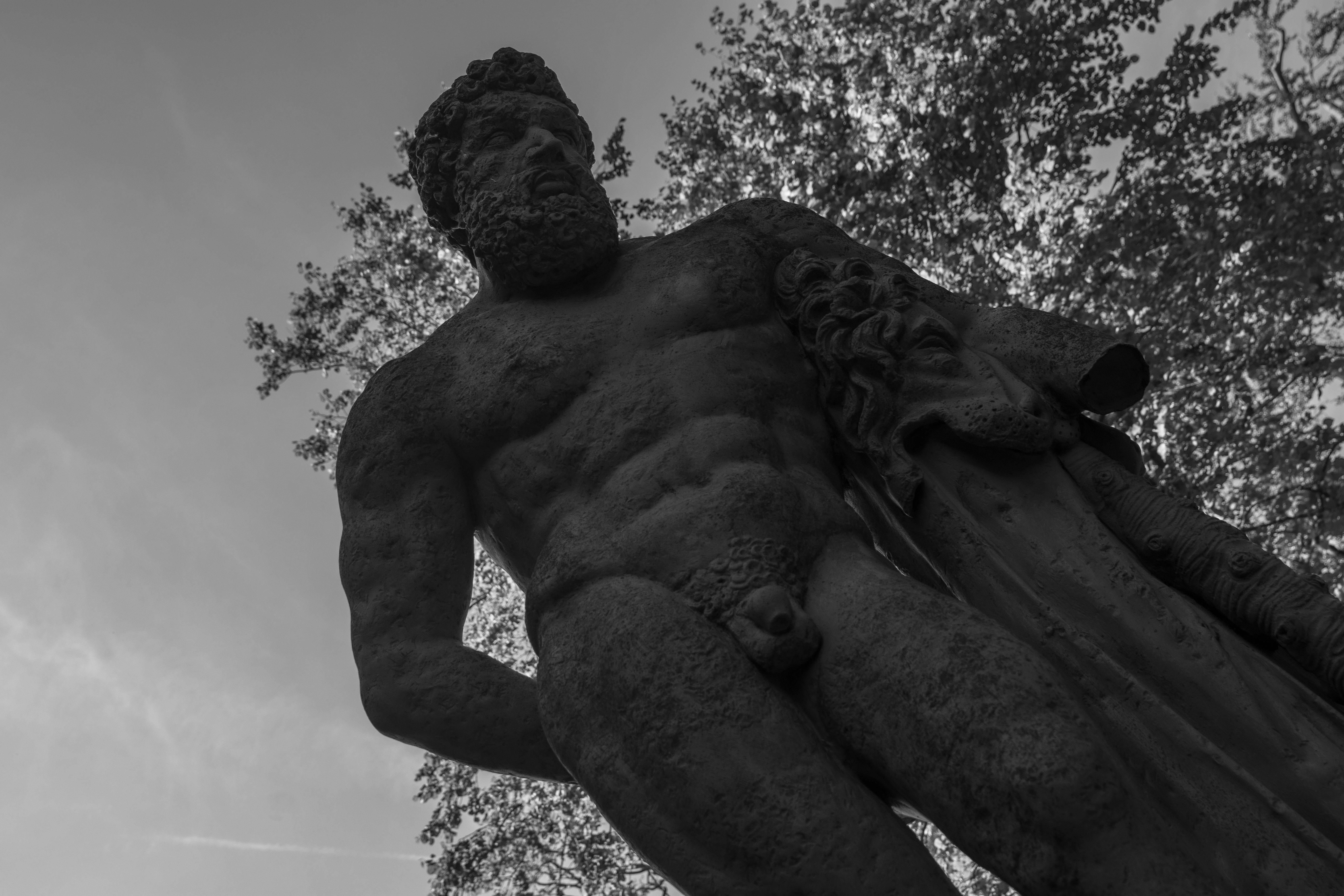
...and Hercules, commissioned in the 1720s and originally positioned at the castle entrance before being moved to his elevated castle vantage point.


So there, in a nutshell, is my very limited knowledge of our relatively fleeting visit to Chirk, but I love a reason to return!

As we travelled along the old Roman road (the A5, which runs diagonally across Britain from Anglesey in north-west Wales to Dover in south-east England), the scenery flanking the road sides grew ever taller, greener and tree lined...


but if you're ever in any doubt that you've arrived in Wales, the bilingual road signs are often the first clue, invariably followed by sightings of the Welsh flag, featuring the red dragon.

The Welsh kings of Aberffraw first adopted the dragon in the early 5th century in order to symbolise their power and authority after the Romans withdrew from Britain and on Saturday 13th August, we experienced the heat of the dragon's breath.  It's not customary to expect good weather in Wales, but we certainly received a warm welcome at our destination on Saturday in every sense; blistering sunshine, not even the whisper of a breeze, clear skies and a holiday cottage purpose built for me.  

Pen-y-Bont is a detached thick stone walled cottage dating back to the 16th century (the oldest building in this Conwy Valley village), accessed by a footbridge over a babbling brook...

...or via a series of stepping stones.

Here I am outside (photo from later in the week), looking around 4 inches tall and breaking all the fashion rules in double denim with style sinner walking shoes.

So far, so idyllic.  But the fun didn't stop there.  The cottage was 20 seconds' walk away from the charming Ty Gwyn Hotel and - be still my beating heart - no more than 20 paces away from an abandoned graveyard, nestling within a glade next to the stream.


Inside, we immediately put the wine from our generous welcome pack left by Paul, the owner, to chill, unpacked and soaked up the sun and the smell of the numerous roses surrounding the cottage.

After a good night's sleep, I woke early on Sunday morning and, a little bleary eyed, headed straight outside into bright sunshine - still in my nightie (Dilli Grey) - to paddle in the stream, thinking I had found my happy place and enjoying the warming fiery breath of the Welsh dragon on my skin.

Shortly after, and fully clothed, I met local gent Ken, a lifelong village resident who was keen to show me the Grade 2 listed Seion Chapel just up the hill from our cottage.  


Built in 1841, the chapel contained an exhibition on the growth of Nonconformism and photos and descriptions of the lives of the local community in the early 20th century.  

Ken, however, had other ideas.  He fired (friendly fire) a million questions at me:  Had I visited before?  How long would I be here?  Did I believe?  What did I do?  Hobbies and interests?  Was I on the internet?  Did I live in a multi cultural community?  Could I identify him from a school photo on display in the chapel?  Could I pick out the village's other famous former resident, Paula Yates (Punk Princess, author, former wife of Bob Geldof, former girlfriend of Michael Hutchence) from her school photo - also on display?  

I managed to get a couple of shots of the ceiling roses, typical of chapels of this era...


... and the view from one of the windows...

...all the time fielding questions from Ken.

Did I live in Birmingham?  It was at this point I tried to explain that Birmingham and the Black Country were not one and the same. However, I think this fell on deaf ears. I tried naming a few of our own famous local heroes, but he had never heard of Led Zeppelin, telling me he was more of a male Welsh voice choir man. He resumed his questioning. Parents still alive?  Would I sign the visitors book?  He then willingly posed for a photo before issuing me with a list of places to visit, kissing me on the cheek and wishing me a lovely holiday.

I left the chapel that morning a little stunned, quite exhausted, but chuckling to myself and armed with a plan of action.

See you soon for more Welsh tales.


A Fond Farewell

We've all heard of the proverbial "pain in the neck."  Well, for the longest time, I've been waking up with a cricked neck...